 ISHOT MILITARY ACADEMY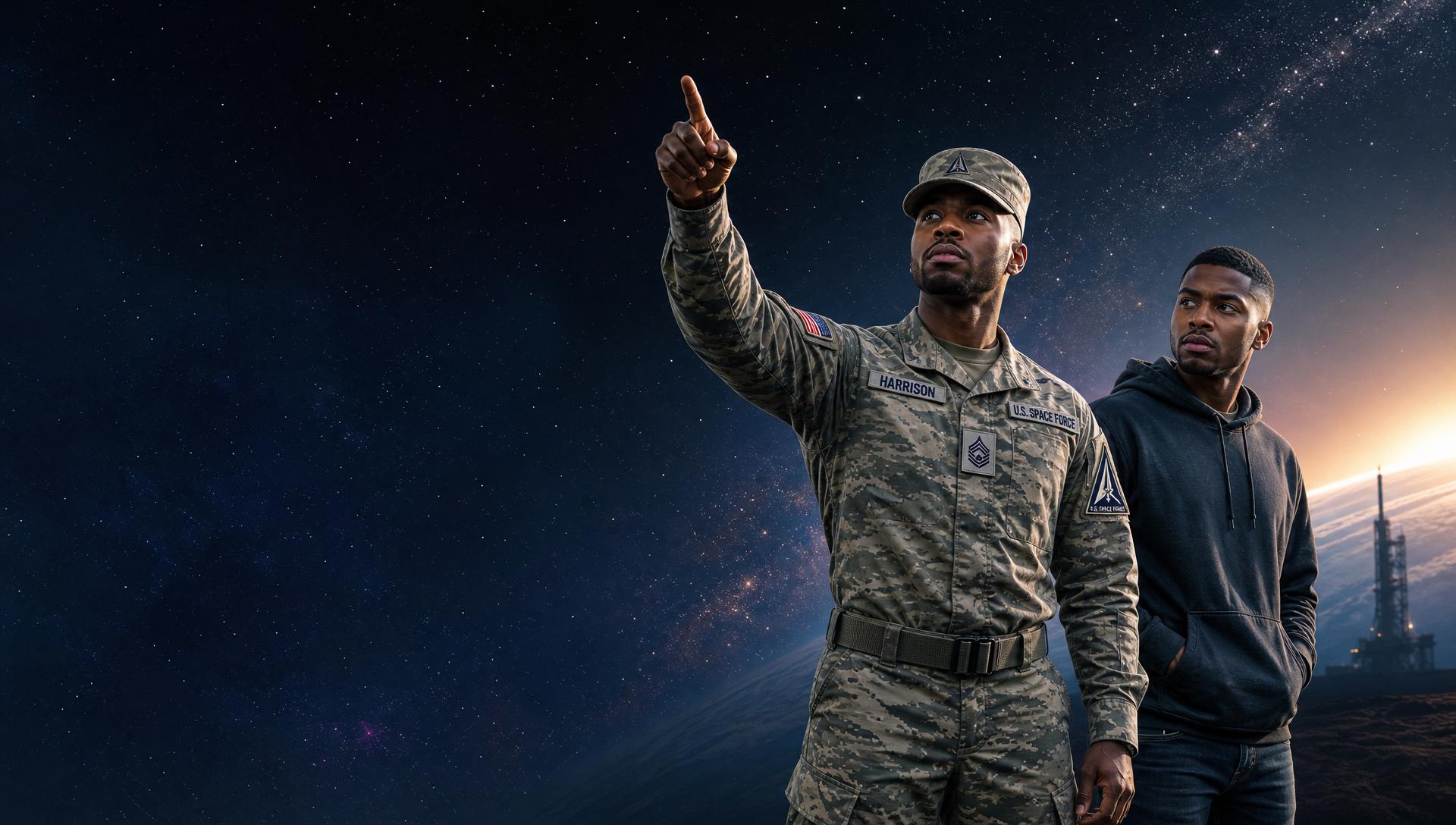
Space Force
"Semper Supra (Always Above)"
To secure the Nation's interests in, from, and to space.
Mission
To secure the Nation's interests in, from, and to space.
- Headquarters
- The Pentagon, Arlington, VA
- Founded
- 2019
- Active duty
- 8,600
- Reserve
- —
History
The United States Space Force was established 20 December 2019 as the sixth independent branch of the U.S. Armed Forces — the first new military service since 1947. Its lineage traces to Air Force Space Command, and its mission has grown as space became a contested warfighting domain.
Core Values
Culture
Guardians are building a culture from scratch: lean, technical, and highly selective. The service prizes technical mastery, mission focus, and a small-team ethos. Because the branch is so small, individual Guardians have unusual visibility and influence early in their careers.
Lifestyle
Most Guardians serve at fixed installations and work in shift-based operations rooms — orbital warfare, missile warning, satellite communications, cyber, and intelligence. Life is more like a technical civilian job than a traditional combat-arms unit: predictable schedules, technical training pipelines, and strong emphasis on continuing education.
Daily Life
Guardians typically report for a shift on the operations floor, hand over from the previous crew, and conduct real-time monitoring, threat assessment, or satellite command. Between shifts: training, briefings, physical fitness, and continuing education. Field exercises exist but are less physically punishing than in ground services.
Training Pipeline
- 1
Basic Military Training (BMT)
8 weeksLackland AFB (JBSA), San Antonio, TXAttended alongside Air Force trainees — Guardians branch off for space-focused instruction
- 2
Technical Training
Vandenberg SFB, Peterson SFB, Goodfellow AFB (and others)Orbital warfare, cyber, intelligence, or space systems operations
Pay
DoD pay chart applies. Guardians receive the same pay as other services at equivalent rank/TIS.
Common allowances & special pays
All U.S. military branches share the same DoD basic-pay chart. Bonuses, sea/flight pay, and BAH depend on your rank, MOS/AFSC/rating, and duty station. Refer to DFAS for current amounts.
Benefits
Promotion System
Specialist 1 (E-1) through Chief Master Sergeant (E-9)
No warrant officer program at launch — under study
O-1 to O-10
Career Categories
Full job-by-job breakdowns land with the Military Career Library.
Deployments
Space Force personnel primarily operate from fixed installations; deployments exist but are limited compared to other services
Common regions
Most Guardians serve at home stations conducting 24/7 space operations.
Housing & Family Life
- on base
- Dorms for junior enlisted; base and off-base housing with BAH
- overseas
- Limited overseas locations
- Airman & Family Readiness Centers (shared with Air Force)
- Child Development Centers
- DoDEA schools at joint bases
Is this branch for me?
Who should join
- Candidates with strong STEM aptitude
- Those interested in cyber, intelligence, orbital warfare, and satellite operations
- People who want to shape a brand-new service
- Newest branch — outsized influence and leadership opportunities early
- Cutting-edge technical work in orbital, cyber, and intelligence domains
- Highest concentration of technical experts in DoD
- Very selective — small, focused force
- Extremely small number of accessions each year
- Limited variety of career fields
- Most billets are CONUS with fewer overseas assignments
Typical career paths
- Enlisted (Specialist 1 → CMSgt equivalent)
- Officer via USAFA, ROTC, or OTS with USSF selection
- Direct commission for cyber and technical specialists
Civilian opportunities after service
Frequently asked questions
Is the Space Force actually its own branch?
Yes — it became the 6th independent branch in December 2019 under the Department of the Air Force.
How big is the Space Force?
The smallest U.S. military branch — around 8,600 uniformed Guardians.
Do Guardians go to a special boot camp?
No — Guardians attend BMT at Lackland with the Air Force, then diverge for technical training.
Is there a reserve component?
The Space Force is standing up a part-time component (Space National Guard integration is under debate); today there is no separate USSF Reserve.